

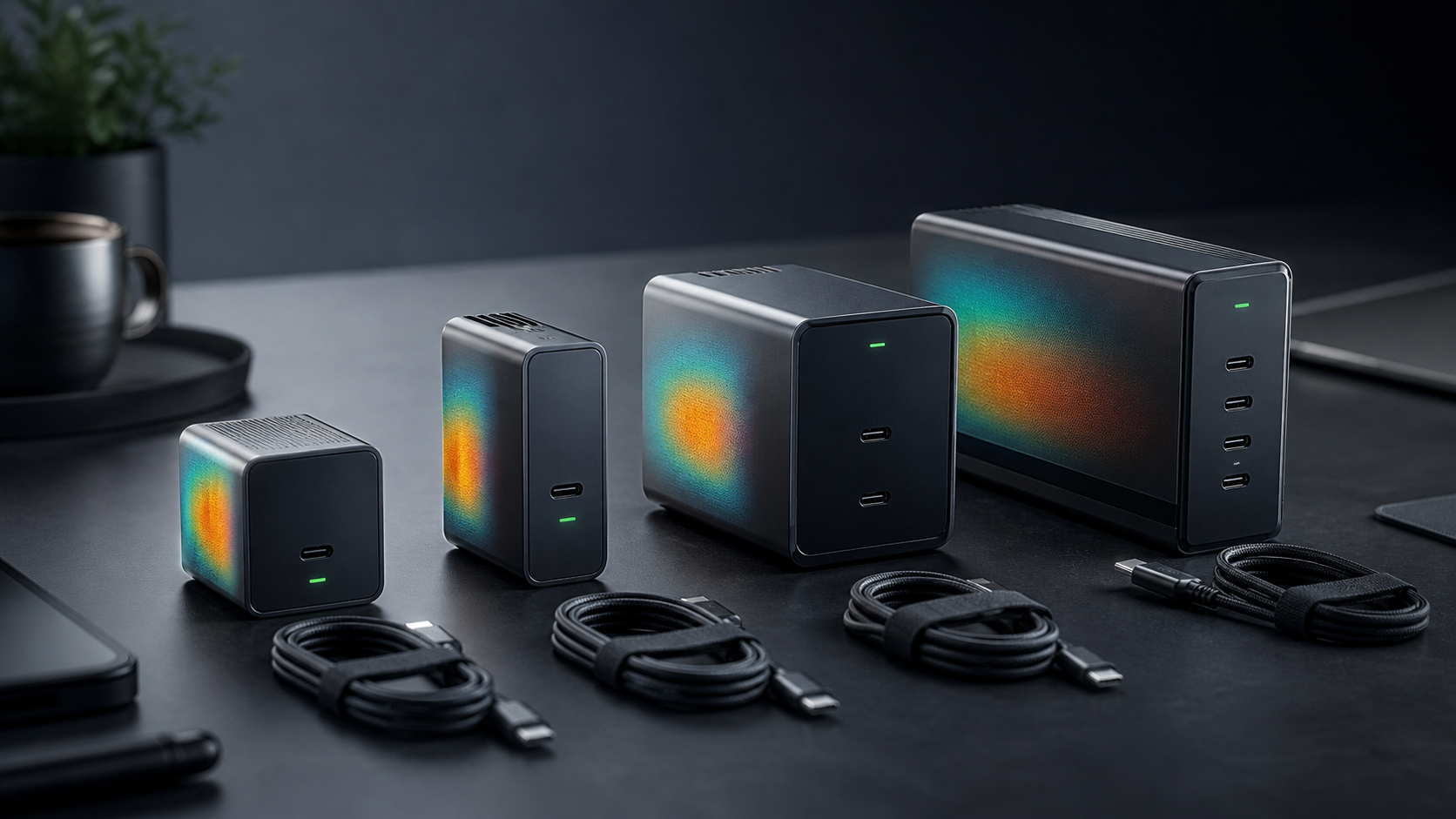
The charger market in 2026 has completely transformed. With the introduction of USB-PD 3.1's EPR (Extended Power Range), high-voltage rails of 28V, 36V, and 48V allow a single USB-C connection to deliver up to 140W and even 240W. Simultaneously, GaN (Gallium Nitride) components have evolved to deliver the same wattage in a smaller form factor with lower heat output. However, this is where the problems arise. Choosing a charger based solely on the 'total 240W' label can lead to disappointment.
Even among chargers rated for 240W, some models cap USB-C output at 140W, while others may halve the output when two devices are connected. Heat management also varies; some chargers maintain a surface temperature of 41℃ while delivering 140W for 30 minutes, whereas others can reach 61℃. In this article, we will compare the four brands: Anker Prime, Ugreen Nexode, Apple, Baseus across five key metrics: ① maximum output per port ② multi-port distribution rules ③ heat generation ④ efficiency and standby power ⑤ EPR cable requirements, concluding with recommended configurations for different device combinations. The data is based on verified measurements and official specifications as of November 2026.
1. First, the Specifications: How PD 3.1 EPR Changes the Game
Previously, PD 3.0 had a maximum output of 20V/5A = 100W. PD 3.1 introduces EPR mode, adding fixed rails of 28V (140W), 36V (180W), and 48V (240W), along with an adjustable voltage mode called AVS that allows fine-tuning between 15V and 48V. However, there are three important caveats.
- Cables are the gateway: To deliver over 100W at 5A, you need a 5A cable with an e-marker chip, and to exceed 140W, a 240W EPR-rated cable is mandatory. Using older cables instead of the included ones will limit even the best chargers to 60-100W.
- Rated watts ≠ single port output: Even if a charger is labeled as 'total 240W', most models have a maximum single port output of 140W. If you're charging devices like the 16-inch MacBook Pro that require over 100W, you should first check the maximum output per port.
- EPR negotiations can fail in high-temperature environments: According to large-scale measurements, most certified products succeed in negotiating above 44V at a room temperature of 25℃, but the success rate drops to 68% at 35℃ and further to 35% at 40℃, reverting to 28V (140W) or 36V (180W). If you're using chargers on a desk or windowsill during summer, products with better heat management will be advantageous.
2. Quick Comparison of Representative Lineups from Four Brands
| Category | Anker Prime 240W (3C1A) | Ugreen Nexode 240W/200W (3C1A) | Apple 140W (1C) | Baseus GaN5 Pro 100W (3C1A) |
|---|---|---|---|---|
| Position | Flagship Desk & Multi-Port | Value Flagship Multi-Port | Single-Port for MacBook | 100W Value Travel |
| Max Output per Port | 140W (USB-C1, 28V EPR + AVS) | 140W (USB-C1, 28V EPR) | 140W (28V EPR) | 100W (PD 3.0, no EPR) |
| PPS Support | 3.3-11V/5A | 5-21V/5A Full Range (compatible with Galaxy SFC 2.0 45W·S25 Ultra 60W) | Not Supported | Varies by model |
| Multi-Port Distribution | C1 always guarantees 140W + C2/C3/A total 100W, no output interruption when disconnecting (PowerIQ 4.0) | Re-negotiation occurs when adding devices; C3+A combination may experience momentary interruption | — (Single Port) | Check distribution chart for port combinations |
| Heat Generation at 140W for 30 Minutes | Surface max approx 41℃ (at 21-23℃ room temperature), heavy and thick heat dissipation structure | Main body approx 44℃, USB-A port area approx 61℃ | Certified equivalent (optimized for MacBook heating) | Not applicable as it is 100W rated |
| Efficiency & Standby Power | Conversion efficiency approx 90% (including 25% load), standby approx 0.15W (Class VI), PFC equipped | Standby power at Class VI level | Class VI | Class VI |
| Weight & Size | Main body only 539g (32×102×72mm) — Desk Type | 409g | Approximately 350g | Ultra-compact travel |
| Strengths | EPR AVS, uninterrupted port re-negotiation, lowest standby power | Full PPS range, PD 12V support (can replace 12V DC), low actual retail price | Optimal compatibility with MacBook & iPhone, proven safety | Most affordable and compact for 14-inch MacBook |
| Cautions | Weight 539g, some EPR cable compatibility issues, no 12V rail support | No AVS EPR support, power re-negotiation when using C3 and A simultaneously | Only one port, no full PPS support, higher unit cost | Cannot fully charge 140W laptops (no EPR support) |
3. In-Depth Analysis by Brand: What is Each Charger For?
Anker Prime — The Benchmark for 'Uninterrupted Multi-Port'
The essence of Anker Prime 240W is not just wattage, but the port distribution policy and re-negotiation quality. USB-C1 always guarantees 140W, while the remaining three ports share 100W, allowing you to charge your laptop while connecting a phone, tablet, or earbuds without affecting the main device's charging speed. Additionally, thanks to PowerIQ 4.0, when you plug or unplug a device, the power to other ports does not cut off — a significant difference for professionals using laptops during video conferences. With a standby power of about 0.15W and PFC (Power Factor Correction), it is optimal for desk charging left plugged in 24/7. However, you must accept its weight of 539g and dependency on accessory cables (no 12V rail support).
Ugreen Nexode — The Champion of 'Specs vs. Price'
Nexode 200W/240W (3C1A) supports 28V EPR 140W on C1 like Anker but is priced lower. With 5-21V/5A full-range PPS, it excels in compatibility with Galaxy and Pixel charging, and PD 12V support allows for replacing 12V power adapters with USB-C. However, there are clear drawbacks. Without AVS EPR, voltage fine-tuning is lacking, and during actual measurements, the area near the USB-A port reached 61℃ under a 140W load for 30 minutes. While the main body temperature remains stable at around 44℃, the heat tends to concentrate at the port area, so avoid placing it in poorly ventilated spots. Additionally, using C3 and USB-A together may cause momentary power re-negotiation.
Apple 140W — A Choice for Simplicity at a Price
The 140W adapter that comes with the 16-inch MacBook Pro is a genuine PD 3.1 product supporting 28V EPR. It has only one port and lacks PPS, but its compatibility with Apple ecosystem devices, safety certification, and heat tuning are still top-notch. For those who do not need multi-port functionality and only charge a MacBook or iPhone, and require reliability across any cable or device combination, it remains a sensible choice. However, the fact that you could buy an EPR multi-port charger for the same price is becoming a burden.
Baseus GaN5 Pro — The Value Solution in the 100W Range
The Baseus GaN5 Pro 100W is designed for those who do not need EPR. It is built for the 14-inch MacBook Pro with a 96W adapter in mind, and most combinations of 14-inch laptops, tablets, and phones are adequately served by 100W. Offering three ports (2C1A) with full 100W charging at this price and size is its core value. However, to extract the maximum 100W from the C port, a 5A e-marker cable is necessary, and there are clear limitations for fully charging 140W laptops or setting up a 240W desk configuration. As a portable auxiliary adapter, it remains one of the best balances in 2026.
4. Recommended Configurations by Device Combination
| User Profile | Recommended Product | Reason and Configuration |
|---|---|---|
| MacBook Pro 16 + iPhone + iPad (Fixed in Office) | Anker Prime 240W | C1 always guarantees 140W + uninterrupted re-negotiation, optimal for constant connection with the lowest standby power |
| Windows Laptop + Galaxy Phone + Earbuds (Value Desk) | Ugreen Nexode 200W/240W | Full-range PPS for fastest Galaxy charging at 45-60W, EPR 140W support for laptops, low actual retail price |
| MacBook Only, Preferring Simplicity | Apple 140W | Complete compatibility with Apple devices and verified heat design, sufficient for those who only need a single port |
| MacBook 14 + Tablet (Travel/Cafe Use) | Baseus GaN5 Pro 100W | 100W is sufficient for a 14-inch laptop, ultra-compact and lightweight for optimal mobility (5A cable required) |
| More than 5 Devices, Desk Organization (Including Monitor & Lighting) | Ugreen Nexode 500W Desk Station | 5C1A total 500W, single C1 up to 240W — but weighs 2.2kg, not portable |
📌 Editor's Three-Line Summary
- The standard in the PD 3.1 EPR era is not 'total wattage' but maximum output per port (140W = 28V rail) and 240W EPR cable requirements.
- For heat management and uninterrupted performance, Anker Prime excels (41℃, no re-negotiation), while Ugreen Nexode offers compatibility and value (full PPS, PD 12V). For simplicity and MacBook exclusivity, Apple 140W is ideal, and for portable value, Baseus GaN5 Pro 100W stands out.
- Be aware that EPR negotiations may fail in high-temperature environments (68% success rate at 35℃), so choose desk chargers with good heat dissipation for summer use.
USB-IF USB Power Delivery Official Specification Document · Anker Official Site · Ugreen Official Site · Baseus Official Site