

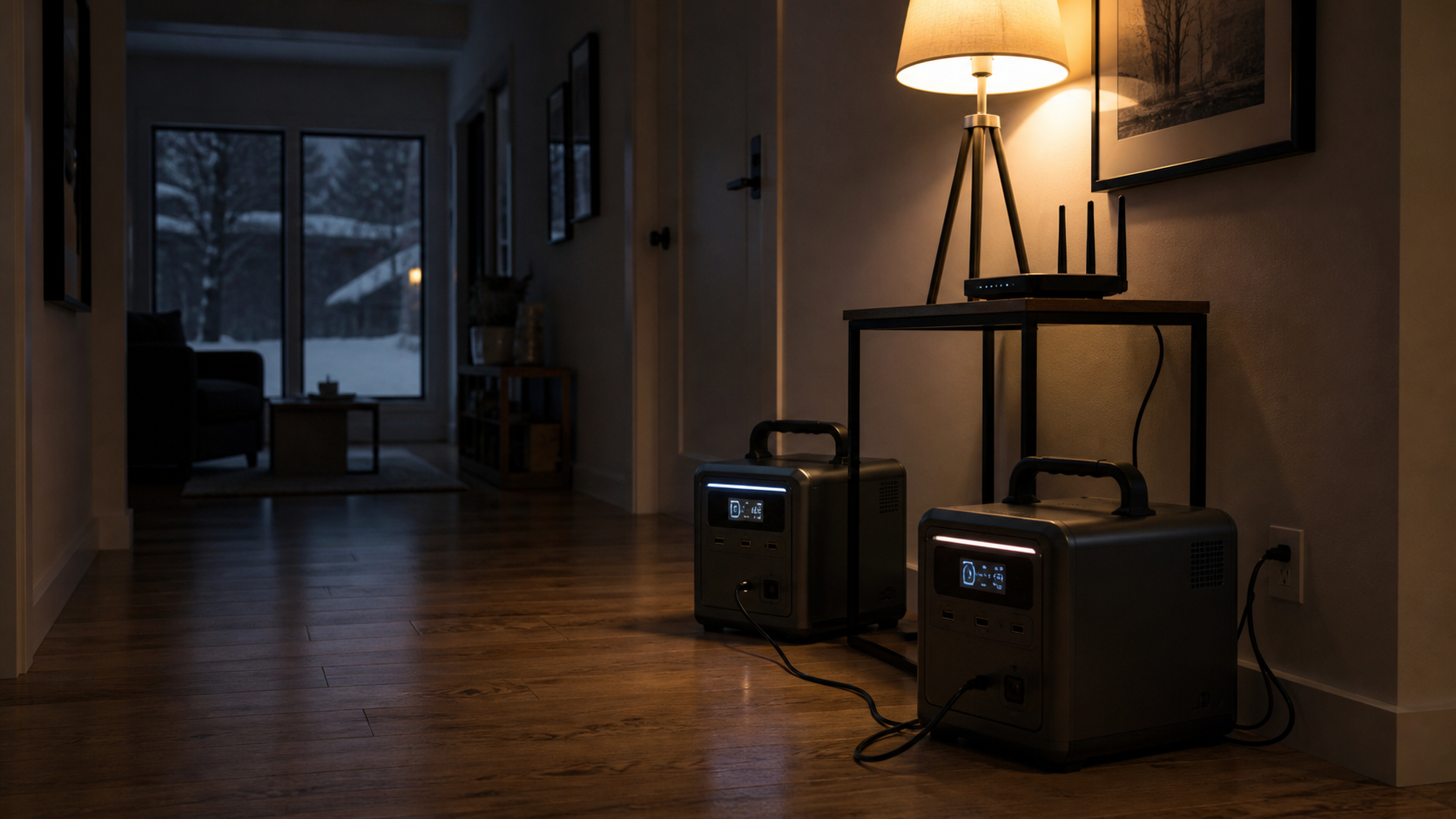
Winter power outages can strike without warning. Just like the severe cold snap that hit the southern United States in January 2026, when power goes out, the first things to stop working are not the heating systems but rather the refrigerator, router, and medical devices. This is why the most popular backup power solution in American households today is not large generators, but rather 2kWh portable power stations. They are silent, smoke-free, and can be conveniently used in the living room.
This article revisits the four most compared models in the U.S. market as of November 2026, using the same criteria. The contenders are the EcoFlow Delta 3 Plus (1,024Wh·1,800W), Jackery Explorer 2000 v2 (2,042Wh·2,200W), Anker SOLIX C2000 Gen 2 (2,048Wh·2,400W), and Bluetti Elite 200 V2 (2,073.6Wh·2,600W). Instead of simply copying the spec sheets, we translated the differences into what actually changes during a power outage.
📌 3 Key Takeaways
- Only 85% of the rated capacity is usable. Actual AC output from 14 devices in studies ranged from 75% to 93% of their rated capacity. A 2kWh power station realistically provides enough power for a "day of refrigeration".
- The cost per Wh is Bluetti $0.43 < Anker $0.44 < Jackery $0.49 < EcoFlow $0.70. While EcoFlow Delta 3 Plus has half the capacity, it is the lightest and quietest at 12.5kg and 41dB, making it ideal for apartments and studios.
- The critical factors in winter are two numbers that are often overlooked in spec sheets — UPS transition time (7–20ms) and standby consumption (0.4–2.5% per hour). If you plan to store the device for six months, choose one with lower standby consumption.
1. Not All '2kWh' Power Stations Are Created Equal
The most common misconception is to treat these four models as equals and simply pick the cheapest. In reality, they represent one 1kWh unit and three 2kWh units, with weights ranging from 12.5kg to 24.2kg, nearly double. This difference determines whether you will keep it at home or transport it in your vehicle.
- EcoFlow Delta 3 Plus (1,024Wh·1,800W): Rated at 1,800W (surge 3,600W), can handle resistive loads up to 2,200W with X-Boost. AC input of 1,500W charges from 0 to 100% in 56 minutes, with solar input from two 500W panels for a maximum of 1,000W. LFP cells rated for 4,000 cycles (up to 80%), 12.5kg·398×200×283mm, UPS transition time <10ms, and <30dB noise at 600W load. Can be expanded to a maximum of 5kWh with additional batteries and comes with a 5-year warranty.
- Jackery Explorer 2000 v2 (2,042Wh·2,200W): Surge capacity of 4,400W, with three AC outlets. LFP cells rated for 4,000 cycles (maintaining over 70%). 17.9kg, AC input of 1,800W charges in about 1.75 hours, with solar input from two panels for a maximum of 400W. UPS transition time <20ms, fan noise ≤30dB, standby consumption of 18W. Comes with a standard 3-year warranty plus an optional 2-year extension (up to 5 years), no expansion battery support.
- Anker SOLIX C2000 Gen 2 (2,048Wh·2,400W): Surge capacity of 4,000W, with five AC outlets. LFP cells rated for 4,000 cycles (up to 80%), 18.9kg, solar input up to 800W, and UPS transition time of 10ms (manufacturer's specification). Can be expanded to about 4kWh with the BP2000 Gen 2 expansion battery, and comes with a 5-year warranty.
- Bluetti Elite 200 V2 (2,073.6Wh·2,600W): Surge and power lifting capacity of 3,900W (limited to resistive loads), with four AC outlets. LFP cells rated for over 6,000 cycles (up to 80%), the longest in this group. 24.2kg, the heaviest, with solar input up to 1,000W, UPS transition time of 15ms, and a 5-year warranty.
In summary: EcoFlow is the lightest and quietest, Bluetti and Anker offer the best price per capacity and cycle life, while Jackery excels in brand support and simplicity. Which one is the "better device" ultimately depends on your home's layout.
2. Viewing Specs in One Table (Based on Manufacturer Specifications as of November 2026)
| Category | EcoFlow Delta 3 Plus | Jackery 2000 v2 | Anker SOLIX C2000 Gen 2 | Bluetti Elite 200 V2 |
|---|---|---|---|---|
| Rated Capacity | 1,024Wh | 2,042Wh | 2,048Wh | 2,073.6Wh |
| Continuous AC Output | 1,800W | 2,200W | 2,400W | 2,600W |
| Surge (Peak) | 3,600W | 4,400W | 4,000W | 3,900W |
| Battery Type | LFP | LFP | LFP | LFP |
| Cycles (Rated) | 4,000 → 80% | 4,000 → 70%↑ | 4,000 → 80% | 6,000+ → 80% |
| Weight | 12.5kg | 17.9kg | 18.9kg | 24.2kg |
| AC Charging (0→100%) | 56 minutes (1,500W) | About 1.75 hours (1,800W) | About 1.4 hours (1,800W) | About 1.4 hours (1,800W) |
| Max Solar Input | 1,000W | 400W | 800W | 1,000W |
| UPS Transition | <10ms | <20ms | 10ms (measured 7.2ms) | 15ms |
| Standby Consumption | About 2.5% per hour with inverter on | Standby 18W | 0.41% per hour | Not specified by manufacturer |
| Expansion | Up to 5kWh | Not available | About 4kWh | Not confirmed |
| Warranty | 5 years | 3+2 years | 5 years | 5 years |
| U.S. Sale Price (Nov 2026) | $550–800 | $900–1,000 | $700–900 | $700–900 |
3. The Real Comparison is 'Cost per Wh'
When rated capacities differ, direct price comparisons are meaningless. Based on the prices as of November 2026, we calculated the cost per capacity.
| Device | Listed Price | Rated Capacity | Cost per Wh | Usable (×0.85) |
|---|---|---|---|---|
| Bluetti Elite 200 V2 | $899 | 2,073.6Wh | $0.43 | About 1,763Wh |
| Anker SOLIX C2000 Gen 2 | $899.99 | 2,048Wh | $0.44 | About 1,741Wh |
| Jackery Explorer 2000 v2 | $999 | 2,042Wh | $0.49 | About 1,736Wh |
| EcoFlow Delta 3 Plus | $719 | 1,024Wh | $0.70 | About 870Wh |
At first glance, EcoFlow appears to be the least efficient. However, this table does not account for weight, noise, charging speed, and expandability. The reason EcoFlow's cost per Wh is 60% higher is due to its 12.5kg body housing a 1,500W charging circuit and a fan that operates at <30dB. For homes where devices need to be moved frequently, like studios or small apartments, this premium is not a waste. Conversely, if you plan to use it only as a backup during outages, the 2kWh unit with the lowest cost per Wh is the best choice.
4. How Many Days Can You Last with 2kWh?
This is the key question for power outage preparedness. By multiplying the rated Wh by a 0.85 factor, we calculate the usable capacity and divide it by the average power consumption of each device (accounting for inverter losses, reserve protection, and continuous consumption).
| Load | Average Power Consumption | 2kWh Unit (Usable 1,740Wh) | 1kWh Unit (Usable 870Wh) |
|---|---|---|---|
| Refrigerator (Energy Star 20cu.ft, duty cycle considered) | About 55–65W | About 27–31 hours | About 13–16 hours |
| Wi-Fi Router + Optical Network Terminal (ONT) | About 20W | About 87 hours | About 43 hours |
| CPAP (without humidifier) | About 30W | About 240Wh for 8 hours | About 240Wh for 8 hours |
| CPAP (with humidifier) | About 60–90W | 480–720Wh for 8 hours | One night is the limit |
| LED Lights (3-4 units) | About 20W | About 87 hours | About 43 hours |
| Laptop + Monitor | About 80W | About 21 hours | About 10 hours |
| Electric Heater (1,500W) | 1,500W | About 70 minutes | About 35 minutes |
| Gas Boiler Blower (400W) | About 400W | About 4 hours (shorter if ignition is repeated) | About 2 hours |
The conclusion from this table is clear. Electric heating cannot be sustained by a power station. A 1,500W heater will drain 2kWh in just 70 minutes. To maintain body temperature during a winter outage, alternatives like generators, stoves, or sleeping bags are necessary, not batteries. The role of a power station is to support refrigeration, communication, lighting, and medical devices.
5. UPS Transition and Standby Consumption: The Most Underestimated Numbers in Spec Sheets
During a power outage, the UPS transition time determines whether your PC, NAS, and router can withstand without rebooting. All models in this group have transition times under 20ms, which falls within the range tolerated by standard computer power supplies. Measured data shows that the Anker C2000 Gen 2 has a transition time of 7.2ms, while the EcoFlow Delta 3 Plus measures 10.2ms. Medical devices (like CPAPs and insulin coolers) often do not guarantee UPS usage, so it's essential to consult the device manufacturer and conduct real overnight tests.
The more practical number is standby consumption. If left powered on for months, the battery will self-discharge. Based on available measured and manufacturer data, the Anker C2000 Gen 2 has a standby consumption of 0.41% per hour, while the EcoFlow Delta 3 Plus consumes about 2.5% per hour with the inverter on. The latter means that in 24 hours, 60% of the charge could be lost, so it’s crucial to check if the device has an 'automatic self-arming' feature that turns the inverter on automatically when a power outage is detected. Devices without this feature require someone to press the button during an outage, during which time the refrigerator will stop.
6. Winter Low Temperatures: Charging Temperature is the Real Limitation
LFP batteries degrade faster when charged below 0℃. Many brands do not specify this condition in their specifications. Jackery discloses that the Explorer 2000 v2 has a charging temperature range of 0–45℃ and a discharging range of -10–45℃. The other three models also do not recommend charging below 0℃, so if you plan to charge them in a garage, balcony, or camping trailer during winter, check if they have built-in heaters (self-heating models).
- Storage Location: For power outage preparedness, keep it in a place that maintains temperatures above 0℃, like a living room or hallway. If stored in a garage, charging may be blocked on the nights when you need it most.
- Long-term Storage: Keeping it at 50–60% is better for the cells than 100% full. However, for power outage preparedness, maintaining 80–100% is advisable, along with checking the charge status once a month.
- Summer: Direct sunlight above 45℃ will trigger output limitations. Avoid storing it near windows or in a car trunk.
7. Consider Solar Recharging as a 'Supplement'
Solar input specs range from 400W (Jackery) to 1,000W (EcoFlow and Bluetti). However, actual power generation on cloudy winter days is typically 20–40% of the rated capacity. If a 400W panel produces 100W on a cloudy day, it would take 20 hours to recharge 2kWh. Thus, solar should be viewed as a supplementary means to sustain during a few days of outage, not a method for immediate recovery.
A practical combination is to have one power station + one small inverter generator (around 2,000W), using the generator solely for charging the power station. The power station can quietly last through the night while the generator runs for only 30–60 minutes during the day to recharge the battery. Running a generator indoors is strictly prohibited due to the risk of carbon monoxide poisoning, and a CO detector should be the first item on your power outage preparedness list.
8. Choosing Based on Situation
| Situation | Recommendation | Reason |
|---|---|---|
| Studio/Small Apartment, Frequent Moves | EcoFlow Delta 3 Plus | Lightest at 12.5kg and <30dB noise. Charges in 56 minutes, expandable to 5kWh. |
| Single-family Home, Focus on Refrigeration + Communication | Anker SOLIX C2000 Gen 2 | 2,400W output, standby consumption of 0.41%, 5-year warranty, expandable to 4kWh. |
| Long Outages, Prioritizing Lifespan | Bluetti Elite 200 V2 | 6,000 cycle rating, 2,600W output, cost per Wh of $0.43. |
| Brand Support + Simplicity Priority | Jackery Explorer 2000 v2 | 3+2 year warranty, 4,400W surge, quiet fan. However, only 400W solar input and no expansion. |
| CPAP Users | 2kWh unit + Overnight Real-Use Test | Humidifier use consumes 480–720Wh. 1kWh units are limited to one night. |
9. Six Things to Check Before Purchase
- Your Refrigerator's Actual Power Consumption: Divide the annual usage (kWh/year) on the label inside the refrigerator by 365 to find the average daily Wh. The 55–65W in the table is based on a 20cu.ft model, so larger side-by-side models will consume more.
- UPS Specification: Products that do not specify transition times may only offer 'pass-through charging' and not true UPS functionality.
- Automatic Self-Arming Feature: Check if the inverter turns on automatically during a power outage. Without this, it only matters if someone is home.
- Warranty and Cell Replacement: Even with a 5-year warranty, cell degradation may not be covered in many cases. Review the exclusions in the warranty document.
- Expandability: If you plan to increase capacity later, choose models with expansion batteries (Anker and EcoFlow). The Jackery 2000 v2 does not support expansion.
- Number and Location of Outlets: The difference between 3 AC outlets (Jackery) and 5 (Anker) will be felt in how many multi-outlet strips you need during an outage. Dedicated outlets like 20A·TT-30R may have different specifications than indicated, so verify.
10. Frequently Asked Questions
Q. How long can 2kWh last?
Using only the refrigerator, router, and lights, it lasts about one day. If the refrigerator runs only at night, it can last 1.5 to 2 days. Adding a CPAP humidifier or electric kettle reduces this to half a day. For outages lasting several days, 2kWh + a charging method (generator or solar) is recommended.
Q. Can I buy this instead of a generator?
The key difference is the ability to operate quietly and without smoke indoors. However, unlike a generator that can run indefinitely with fuel, the stored energy is finite. For urban apartments or studios, a power station is ideal, while for single-family homes with extended outages, both options are practical.
Q. Is it okay to buy used?
LFP batteries have a long cycle life, making used units reasonable, but the charging and discharging history must be verifiable through an app. If the unit does not connect to an app or show cell balance history, compare it to new models with significant warranty left before purchasing.
Q. Are the same standards applicable in Korea?
Korea operates on 220V·60Hz, so you cannot use the 120V models from the U.S. directly. You need to select the domestic officially released model (220V), which has different rated outputs and outlet configurations. Power outages in Korean apartments are typically short, around 1-2 hours, so a combination of a 1kWh unit and a backup battery offers better cost efficiency.
The essence of preparing for power outages is not just purchasing devices but rather deciding what to protect. Food in the refrigerator, baby formula, medical devices for parents, and company NAS. Once you list these priorities, the choice between 1kWh and 2kWh becomes a straightforward calculation.
📌 Editor's 3 Key Takeaways
- Calculate using usable Wh multiplied by 0.85, meaning 2kWh = one day of refrigeration + half a day of communication.
- Cost per Wh ranges from Bluetti $0.43 to EcoFlow $0.70. Weight, noise, and charging speed are key factors in your decision.
- In winter, look for UPS transition (≤20ms), automatic self-arming, standby consumption, and 0℃ charging limitations in the spec sheet. If absent, that’s a weakness.
EcoFlow DELTA 3 Plus Official Specs · Jackery Explorer 2000 v2 · Anker SOLIX · BLUETTI Elite 200 V2 · Ready.gov Power Outage Preparedness Guide