

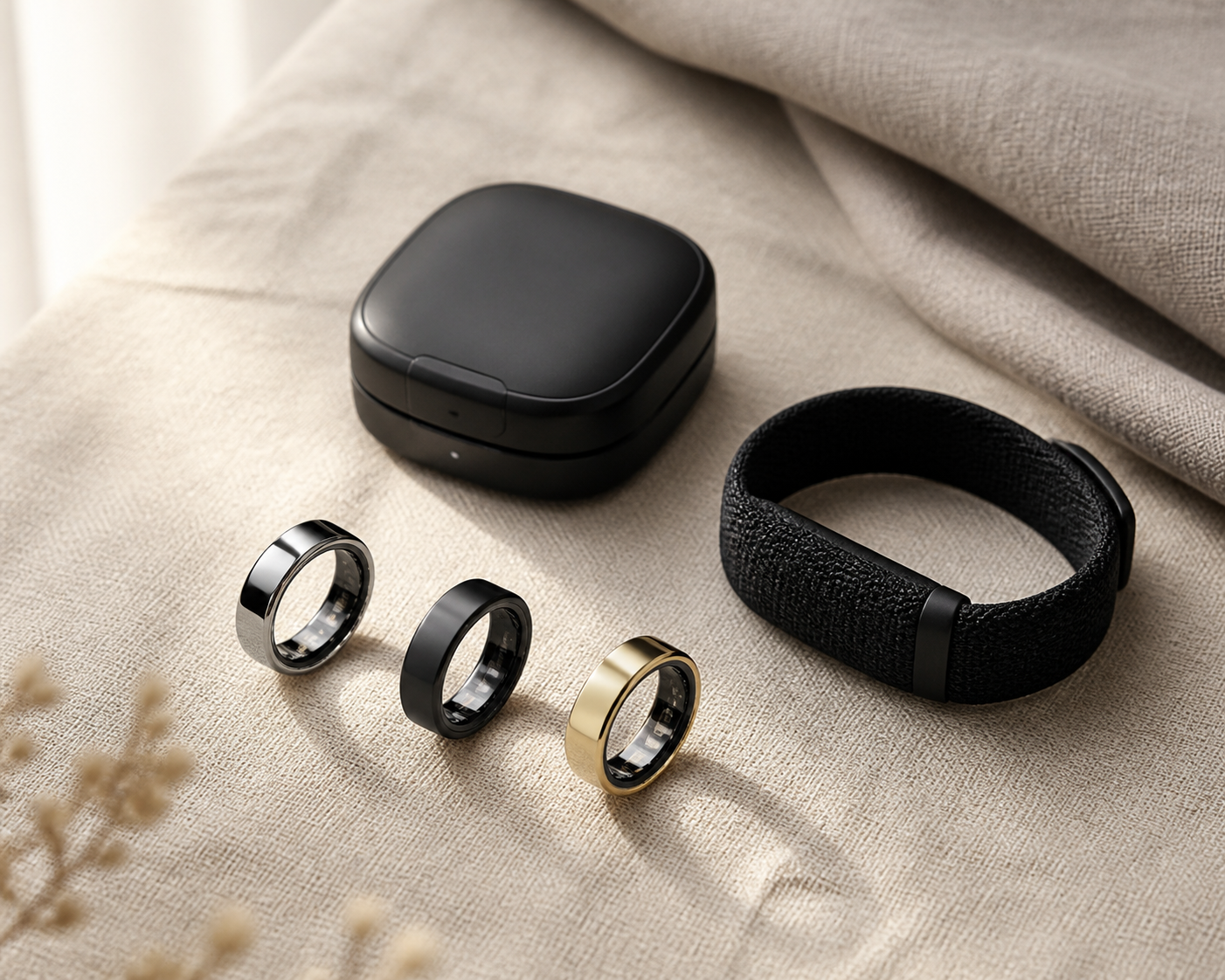
Smart rings are no longer just 'toys for early adopters.' With the release of the Oura Ring 5 in May 2026, finger-worn sleep and recovery trackers have become a category that competes head-to-head with wrist-worn wearables. However, once you visit the purchase pages, you'll find that they all make similar claims: "Improved sleep stage accuracy," "HRV-based recovery analysis," and "Up to 7 days of battery life."
This article revisits those statements through three key questions: ① Is there actual verified evidence? ② What is the total cost over three years? ③ Does it work with my phone? The devices being compared are the four currently available as of November 2026: Oura Ring 5 (released May 2026), Samsung Galaxy Ring (released July 2024, with the next model delayed to 2027), Ultrahuman Ring Air (with its sibling model Ring Pro launched in February 2026), and WHOOP 5.0 (released May 2025, wrist band).
📌 3-Line Summary
- The strongest evidence for sleep stage accuracy still belongs to Oura — the other brands have little peer-reviewed validation data.
- The subscription fees make a real difference. Oura totals $609 over three years, WHOOP ranges from $597 to $1,077, while Galaxy Ring and Ultrahuman end at $399 and $349, respectively.
- Look at the ecosystem before the hardware — the Galaxy Ring does not work at all with iPhones.
1. These Four Devices Do Not Answer the Same Questions
The most common mistake is to list these four as a 'smart ring ranking.' In reality, they are three finger rings + one wrist band, each targeting different users.
- Oura Ring 5 (All-Around Sleep & Recovery): Made of titanium with a unibody design, it is about 40% smaller than Ring 4, measuring 6.09mm wide and 2.28mm thick. Available in sizes 6 to 13, it focuses on 'reading the body's state' through sleep, readiness, and activity scores, with enhanced AI health coaching insights starting from the 2026 version. However, without a $5.99/month ($69.99/year) membership, only three daily scores are visible.
- Samsung Galaxy Ring (Android Ecosystem Only): Priced at $399 with no subscription fee, it is the lightest at 2.3 to 3.3g and comes with a charging case that extends battery life to about 14 days. However, it does not support iOS at all — the Galaxy Wearable app is not available for iPhones. For Samsung phone users, it is the most reasonable choice for the price.
- Ultrahuman Ring Air (Open Data Without Subscription): Costs $349 with no subscription fee, supporting both iOS 15+ and Android 6+. The battery lasts 4 to 6 days, which is on the shorter side, but the higher model Ring Pro ($479), released in February 2026, boasts a maximum of 15 days with the charging case and stores data for up to 250 days. Features like AFib detection are available as a paid add-on (around $49/year).
- WHOOP 5.0 (Exercise Load Focused, Wrist Band): Instead of purchasing a device, you buy a membership. Options include One at $199/year, Peak at $239/year, and Life at $359/year (includes MG hardware and FDA-approved ECG). It has a battery life of over 14 days, with a power pack that allows charging while worn. It is not a ring — if you wanted a ring shape, this option is not for you.
2. Specs at a Glance
| Category | Oura Ring 5 | Galaxy Ring | Ultrahuman Ring Air | WHOOP 5.0 |
|---|---|---|---|---|
| Form | Ring (Titanium) | Ring | Ring (Titanium) | Wrist Band |
| Price | $399 (Silver/Black) / $499 (Gold/Rose, etc.) | $399 | $349 | One $199/year, Peak $239/year, Life $359/year |
| Subscription Fee | $5.99/month / $69.99/year | $0 | $0 (Add-on separate) | Included in membership (not available separately) |
| Battery (Official/Measured) | Up to 7 days / Measured 6-9 days | Up to 7 days (small 6 days), about 14 days with case | 4-6 days (Ring Pro max 15 days) | Over 14 days |
| Water Resistance | 100m (sauna safe, not for diving) | 10ATM / IP68 | 100m (based on continuous 12 hours) | 10m |
| Weight | 3.3-5.2g | 2.3-3.3g | 2.4-3.6g | About 26.5g |
| Phone Compatibility | iOS & Android | Android 11+ only (not compatible with iOS) | iOS 15+ & Android 6+ | iOS 16+ & Android |
| U.S. HSA/FSA Eligibility | Both ring & membership eligible | Check with manufacturer | Ring Pro eligible | Check based on membership path |
3. Sleep Stage Accuracy: What’s Verified and What Isn’t
This is the area most prone to exaggeration in sleep tracker advertising. The current landscape of evidence is as follows.
① Oura has accumulated verified data. A 2025 meta-analysis (OTO Open) that integrated six independent studies (with 388 participants) reported that when compared to laboratory polysomnography (PSG), Oura showed no significant differences in total sleep time (average difference -2.97 minutes), sleep efficiency, wake time after sleep onset, and time spent in each sleep stage at a group average level. A 2024 study (Sleep Medicine) analyzing 96 participants and 420,000 epochs found sleep/wake classification accuracy to be about 92%.
② However, 'stage-specific' accuracy is much coarser. The same study found stage-specific accuracy to be around 75% for light sleep and about 91% for REM sleep. A 2019 study (de Zambotti et al.) reported a tendency to underestimate deep sleep (N3) by about 20 minutes and overestimate REM sleep by about 17 minutes. In other words, "Total sleep time is fairly accurate, but stage classification is approximately correct."
③ Individual cases and sleep disorder patients see worse results. A 2025 study in Scientific Reports reported that in a sleep clinic patient group, the sensitivity for detecting nighttime awakenings dropped to about 46%. Those who toss and turn a lot are likely to be told by the device that they "slept well" when they actually did not.
④ Competing devices have thin evidence. As of October 2026, there are virtually no peer-reviewed validation papers comparing PSG for Galaxy Ring, Ultrahuman Ring Air, RingConn, etc. This does not mean they are "inaccurate" but rather that "there is no verification evidence yet." WHOOP has separate research results showing heart rate accuracy (99.7% during sleep) and sleep/wake agreement at 86%, with stage classification agreement at 60%.
4. HRV: Numbers Don’t Transfer Between Devices
HRV (heart rate variability) is a key marketing point for smart rings, but absolute value comparisons between brands are meaningless. This is due to differences in measurement intervals (nightly average vs. 5-minute windows), the metrics used (RMSSD vs. SDNN), and signal processing methods. Oura's 'HRV 42ms' and WHOOP's 'HRV 42ms' are different numbers with the same name.
Therefore, HRV should only be read as a trend within the same device. A statement like "My HRV this week is lower than last month" is a useful signal, while "My HRV is lower than my friend's" has no meaning. It’s also important to consider that switching devices resets your baseline. This principle is particularly crucial if you plan to switch brands.
5. The Cost Difference Created by Subscription Fees Over Three Years
The actual price of a smart ring is not just the device cost but device cost + subscription fee × years of use. I calculated it assuming a three-year ownership.
| Device | Device Cost | 3-Year Subscription Fee | 3-Year Total Cost | Features Remaining Without Subscription |
|---|---|---|---|---|
| Ultrahuman Ring Air | $349 | $0 | $349 | Full data access |
| Samsung Galaxy Ring | $399 | $0 | $399 | All features (Samsung Health) |
| Oura Ring 5 (Silver/Black) | $399 | $209.97 | $608.97 | Daily 3 scores and battery only |
| WHOOP One | Included | $597 | $597 | None (membership required) |
| WHOOP Peak | Included | $717 | $717 | None (membership required) |
| WHOOP Life (MG·ECG) | Included | $1,077 | $1,077 | None (membership required) |
The differences hidden behind the numbers are more important. If you cancel Oura's membership, only the three scores for sleep, readiness, and activity, along with battery level, remain. In other words, "If you don’t subscribe, it doesn’t become a ring; it’s closer to a ring-shaped battery indicator." Conversely, Galaxy Ring and Ultrahuman show all data without a subscription, but the detailed interpretation and coaching are relatively thin. WHOOP has a high entry cost, but device replacements (when new models are released) are included in the membership, making it potentially more reasonable for long-term users.
6. Ecosystem, Water Resistance, Durability: Minor Yet Daily Conditions
- iPhone Users: The Galaxy Ring is excluded from options due to the lack of an iOS app. Remaining choices are Oura, Ultrahuman, and WHOOP.
- Android & Samsung Phone Users: The Galaxy Ring offers the most practical usability with ecosystem features like gesture control (One UI 6.1.1 or higher) and Find My Ring.
- Swimming & Sauna: Oura is rated for 100m (sauna safe, not for diving), Galaxy is rated for 10ATM/IP68, Ultrahuman is rated for 100m (based on continuous 12 hours), and WHOOP is rated for 10m. If you take swimming seriously, WHOOP's 10m is inadequate, and if you frequently visit saunas, a 100m rated ring is safer.
- Finger Size: Oura Ring 5 has a narrow range of sizes from 6 to 13. If you have slender fingers, the Galaxy Ring (sizes 5 to 15) offers more options. Since a ring that doesn’t fit can disrupt measurements, don’t skip the sizing kit.
- U.S. Residents: Oura provides guidance that both the ring and membership are HSA/FSA eligible, while Ultrahuman indicates the same for the Ring Pro. If you have a workplace health savings account, the actual burden can change significantly, so check eligibility before payment.
7. Conclusion: How to Choose Based on User Type
| User Type | Recommendation | Reason |
|---|---|---|
| iPhone Users Serious About Sleep Data | Oura Ring 5 | Strongest verification evidence + full iOS support + reduced wearing comfort |
| Samsung Phone Users Who Reject Subscription Fees | Galaxy Ring | $399 one-time cost, 14 days with case, ecosystem integration |
| People Who Want to Own Their Data | Ultrahuman Ring Air | No subscription fee, supports both platforms, most affordable, though battery life is short |
| Fitness Enthusiasts Focused on Load & Recovery | WHOOP 5.0 Peak | 14-day battery, body-worn charging, exercise load model, ring not necessary |
Choosing a smart ring isn’t just about picking the one with the highest accuracy. It’s about selecting a device that you can wear daily, charge weekly, and afford the monthly subscription fees. The likelihood of still wearing it six months down the line will determine your satisfaction more than the decimal differences in sleep stages.
📌 Editor's 3-Line Key Summary
- The verification evidence for sleep stage accuracy overwhelmingly belongs to Oura — stage-specific accuracy should be read with the understanding that it is at a 'roughly correct' level of 75-91%.
- Total costs over three years range from $349 to $1,077. A key variable is that if you cancel the subscription, Oura leaves you with only three scores.
- If you use an iPhone, exclude the Galaxy Ring; if you swim, exclude WHOOP — check the ecosystem and water resistance ratings before price.
Official Oura Site · Samsung Galaxy Ring · Official Ultrahuman Site · Official WHOOP Site · Search Oura vs PSG Studies (PubMed)